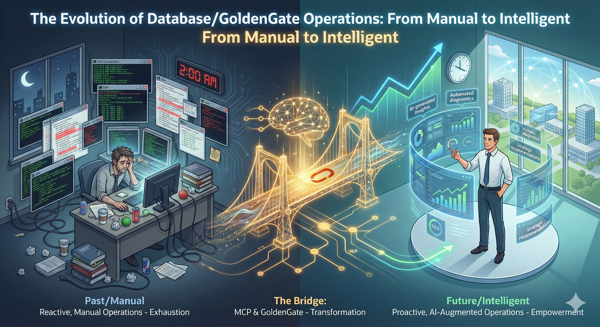
July 2024 marked a turning point in how I think about database and GoldenGate operations, though I didn’t realize it at the time. Over eight days at AIOUG Yatra 24 in India, I presented the same session six times—something I’d never done before. Each time, the conversation after my presentation revealed the same pattern: exhausted DBAs describing manual troubleshooting processes that consumed hours of their time, night after night.
What I witnessed wasn’t just a problem with Oracle GoldenGate management. It was evidence of a fundamental gap between our operational capabilities and the demands modern enterprises place on data infrastructure. And that gap is widening.
The Crisis Hidden in Plain Sight
Here’s what keeps me up at night: we’ve built incredibly sophisticated data architectures—real-time replication, multi-cloud deployments, hybrid environments spanning continents. But we’re still managing them with approaches designed for simpler times. SSH sessions. Command-line interfaces. Manual correlation of diagnostic data. Knowledge trapped in individual heads.
This isn’t sustainable, and it’s certainly not scalable.
During those conversations in India, I heard the same story repeatedly: skilled database professionals spending 30-90 minutes diagnosing issues that follow predictable patterns. Organizations losing money during that diagnostic time. Teams burning out from after-hours alerts. Executives questioning the value of their database operations when every incident feels like starting from scratch.
This is the operational intelligence crisis, and it affects every organization running critical data infrastructure.
Why This Moment Matters
We’re at an inflection point in enterprise technology. For the first time, three critical elements have aligned:
1. Mature API Ecosystems
Oracle GoldenGate’s 350+ REST APIs represent years of investment in programmatic access. Similar API evolution has occurred across the database ecosystem. The infrastructure layer is ready for intelligent automation.
2. Production-Ready AI Capabilities
AI has moved beyond experimentation. Language models can analyze complex technical scenarios, correlate disparate data points, and provide contextual recommendations. The intelligence layer is ready.
3. Standardized Integration Protocols
The emergence of Model Context Protocol (MCP) and similar standards provides the missing connective tissue. We finally have a universal language for connecting AI to enterprise systems.
When Anthropic announced MCP in November 2024 and Oracle immediately embedded it in SQLcl, that wasn’t coincidence. That was confirmation of an architectural pattern that will reshape how we build and operate data infrastructure.
Rethinking the DBA Role: From Reactive to Strategic
Let me be direct: AI won’t replace DBAs. But DBAs who leverage AI will replace those who don’t. And the transition is happening faster than most organizations realize.
GoldenGateMCP represents a specific implementation, but it demonstrates a broader principle: operational intelligence as infrastructure. When you embed diagnostic intelligence into your data architecture, you fundamentally change what’s possible.
Consider this transformation:
Traditional Operations:
- Issue occurs → Alert fires → DBA investigates → Correlates data → Diagnoses → Implements fix
- Time to resolution: 60-120 minutes
- Knowledge: Siloed in individual experience
- Scalability: Limited by available human resources
Intelligence-Enabled Operations:
- Issue occurs → Alert fires → AI analyzes → Provides contextualized diagnosis and ranked solutions
- Time to resolution: 10-20 minutes
- Knowledge: Codified and accessible system-wide
- Scalability: Limited by infrastructure, not headcount
That’s not incremental improvement. That’s a fundamental shift in operational capacity.
The Architecture of Intelligent Operations
Building GoldenGateMCP taught me that successful operational intelligence requires four foundational elements:
1. Context-Aware Integration
Raw API access isn’t enough. You need integration that understands operational context—what’s normal, what’s abnormal, what matters, and what’s noise.
2. Actionable Intelligence
Diagnostic data only has value when it translates to clear next actions. The goal isn’t more information—it’s better decisions.
3. Enterprise-Grade Security
Operational intelligence systems access sensitive infrastructure. Security can’t be retrofitted; it must be architectural.
4. Knowledge Codification
The system should learn from each incident, building institutional knowledge that survives employee transitions and reduces mean time to resolution over time.
This framework applies beyond GoldenGate. It’s the blueprint for operational intelligence across your data infrastructure.
What This Means for Data Leaders
If you’re leading database operations, data engineering, or infrastructure teams, this shift creates both opportunity and risk.
The Opportunity:
Organizations that embrace operational intelligence gain compounding advantages. Faster incident resolution means less downtime. Codified knowledge means consistent operations. Automated diagnostics free your senior people for strategic work.
One financial services client reduced their GoldenGate troubleshooting time by 83%. That’s not just cost savings—that’s strategic capacity. Their senior DBAs now spend time on architecture optimization instead of 2 AM firefighting.
The Risk:
Competitors are already moving. Every quarter you delay adopting operational intelligence, your operational gap widens. Your best people burn out. Your mean time to resolution stays flat while others improve exponentially.
The question isn’t whether to adopt this approach. The question is whether you’ll lead the transition or follow it.
The Broader Industry Shift
GoldenGateMCP is one data point in a larger trend. Look at what’s happening across the industry:
- Oracle embedding MCP in SQLcl
- AWS launching AI-powered database recommendations
- Google integrating Gemini across Cloud SQL
- Microsoft Copilot expanding into database operations
The major vendors recognize that operational intelligence is becoming table stakes. The differentiator isn’t whether you have these capabilities—it’s how quickly you deploy them and how effectively you integrate them into your operational workflows.
A Framework for Implementation
Based on my experience building and deploying operational intelligence systems, here’s how to approach this transition:
Phase 1: Identify Operational Patterns
Where do your teams spend repetitive diagnostic time? What issues follow predictable patterns? Where does knowledge exist only in specific people’s heads?
Phase 2: Build Intelligence Gradually
Start with high-value, low-complexity scenarios. Prove the model. Build confidence. Then expand.
Phase 3: Codify Institutional Knowledge
As you implement solutions, capture the diagnostic logic. Make implicit knowledge explicit. Build systems that learn.
Phase 4: Measure and Iterate
Track mean time to detection, mean time to resolution, and operational capacity freed. Use data to justify expansion and refinement.
This isn’t a rip-and-replace strategy. It’s a gradual transformation of operational capability.
The Strategic Imperative
We are entering an era where operational intelligence becomes a competitive differentiator. Organizations that can diagnose and resolve infrastructure issues in minutes rather than hours operate at a fundamentally different pace than their competitors.
This isn’t about technology for technology’s sake. It’s about strategic capacity—the ability to move faster, operate more reliably, and scale more efficiently than market pressures would otherwise allow.
Your database operations shouldn’t be a constraint on business velocity. They should be an enabler. That’s what operational intelligence makes possible.
Moving Forward
The technology exists. The protocols are standardizing. The question is execution.
GoldenGateMCP represents my contribution to this transition—a concrete implementation proving that operational intelligence isn’t future-state vision, it’s deployable reality. But this is bigger than any single tool.
This is about fundamentally rethinking how we operate data infrastructure in an era where speed, reliability, and efficiency define competitive advantage.
For Technical Leaders:
Challenge your teams to identify where operational intelligence could transform their workflows. Start small, measure results, and scale what works.
For Architects:
Design systems with operational intelligence as a first-class architectural concern, not an afterthought.
For DBAs and Site Reliability Engineers:
Embrace this shift. Your deep technical knowledge becomes more valuable, not less, when augmented with AI. The goal is to multiply your effectiveness, not replace your expertise.
What Success Looks Like
In three years, we’ll look back at manual database troubleshooting the way we now view manual server provisioning. Necessary once, but clearly inefficient compared to modern approaches.
Organizations leading this transition will have:
- DBAs focused on architecture and optimization, not routine troubleshooting
- Mean time to resolution measured in minutes, not hours
- Institutional knowledge codified in systems, not trapped in individuals
- Operational capacity that scales with infrastructure, not headcount
That’s not speculative vision. That’s operational reality for organizations already implementing these approaches.
Join the Conversation
We’re at the beginning of a fundamental shift in how we operate data infrastructure. The frameworks are emerging. The implementations are proving value. The standards are crystallizing.
But this transition requires community. Your experiences, challenges, and insights help shape what comes next. What operational intelligence gaps do you see? Where are the opportunities? What are the barriers?
Let’s coordinate on building the operational intelligence frameworks that will define database operations for the next decade. Because the organizations that move first and move effectively won’t just operate better—they’ll compete on a fundamentally different level.
The question isn’t whether operational intelligence becomes standard practice. The question is whether you’ll help define that standard or adapt to it later.
How is your organization approaching operational intelligence? What challenges are you seeing? What’s working? Let’s have that conversation.
If you would like to see GoldenGateMCP in actions, get in touch through RheoData.
Please follow and like:


Bobby Curtis

I’m Bobby Curtis and I’m just your normal average guy who has been working in the technology field for awhile (started when I was 18 with the US Army). The goal of this blog has changed a bit over the years. Initially, it was a general blog where I wrote thoughts down. Then it changed to focus on the Oracle Database, Oracle Enterprise Manager, and eventually Oracle GoldenGate.
If you want to follow me on a more timely manner, I can be followed on twitter at @dbasolved or on LinkedIn under “Bobby Curtis MBA”.
Follow if you like:


