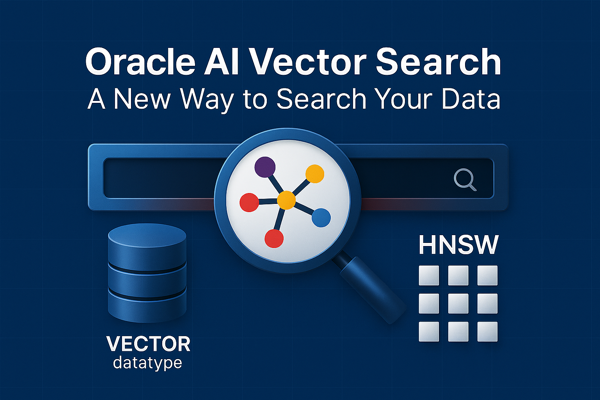
If I had told you five years ago that your Oracle Database would understand the meaning behind your data, not just the words or values stored in columns, you might have thought I was describing science fiction. Yet here we are. Oracle AI Vector Search represents one of the most significant capabilities Oracle has introduced in decades.
As database administrators, we’ve spent our careers optimizing queries, building indexes, and ensuring that when someone asks for information, they get exactly what they requested. But what happens when users don’t know the exact keywords to search for? What about when they’re looking for something similar to what they have, rather than an exact match? This is where Oracle AI Vector Search changes everything.
Understanding Vectors and Embeddings
At its core, a vector is simply an array of numbers. In the context of AI Vector Search, we’re working with vector embeddings, which are mathematical representations of data that capture semantic meaning. These embeddings describe the underlying meaning behind content such as words, documents, audio tracks, or images.
Think of it this way: when you read the words “automobile” and “car,” you immediately understand they refer to the same concept. Traditional database searches wouldn’t connect these terms unless you explicitly built synonyms into your search logic. Vector embeddings capture this semantic similarity mathematically.
Here’s how it works: your unstructured data gets processed through an embedding model (typically a neural network). The model outputs an array of numbers representing the semantic meaning. Similar concepts end up close together in this mathematical space, while dissimilar concepts are farther apart.
The Data Transformation Pipeline
Understanding how data moves from raw content to searchable vectors is essential for successful implementation. Oracle provides several stages:
- Content Extraction: Oracle’s DBMS_VECTOR_CHAIN package extracts text from PDFs, Word files, and other formats.
- Chunking: Large documents get broken into smaller pieces because embedding models have input size limits, and smaller chunks provide more granular search results.
- Embedding Generation: Transform chunks into vectors using in-database ONNX models or external APIs like OpenAI, Cohere, or OCI Generative AI.
- Storage: Vectors are stored alongside your business data using the native VECTOR datatype.
The VECTOR Datatype
Oracle Database 23ai introduced the VECTOR datatype as a first-class citizen. The basic syntax is straightforward:
CREATE TABLE documents (
doc_id NUMBER PRIMARY KEY,
doc_content CLOB,
doc_vector VECTOR(384, FLOAT32)
);
The 384 specifies the dimensions (must match your embedding model), and FLOAT32 is the storage format. Oracle supports INT8 for memory-constrained environments, FLOAT32 for standard precision, FLOAT64 for high precision, and BINARY for specialized similarity metrics.
Performing Similarity Search
The VECTOR_DISTANCE function is at the heart of similarity search. It calculates the mathematical distance between vectors:
SELECT doc_id, doc_title, VECTOR_DISTANCE(doc_vector, :query_vector, COSINE) AS distance
FROM documents
ORDER BY distance
FETCH FIRST 10 ROWS ONLY;
Oracle supports multiple distance metrics: COSINE (most common for text), EUCLIDEAN, DOT product, MANHATTAN, and HAMMING. Most text embedding models work well with COSINE distance.
Exact vs. Approximate Search
Exact search compares against every vector, guaranteeing accurate results but scaling linearly with data size. For datasets under 100,000 vectors, this is typically fast enough. Above that threshold, you’ll want approximate search using specialized vector indexes.
Oracle supports HNSW (Hierarchical Navigable Small World) for in-memory graph-based indexes offering the fastest search, and IVF (Inverted File) for partitioning vectors into clusters when data exceeds memory capacity. The TARGET ACCURACY parameter lets you control the speed-accuracy trade-off.
The Power of Hybrid Queries
Here’s where Oracle’s converged database approach really shines. You can combine vector similarity with traditional SQL predicates in a single query:
SELECT product_id, product_name, price
FROM products
WHERE category = 'Electronics'
AND price BETWEEN 100 AND 500
ORDER BY VECTOR_DISTANCE(embedding, :user_query, COSINE)
FETCH FIRST 20 ROWS ONLY;
This applies business rules while ranking by semantic similarity. This combination isn’t possible with standalone vector databases. It’s a unique advantage of keeping everything in Oracle.
What This Means for Your Role
Consider what happens when a development team needs semantic search capabilities. Without in-house expertise, they’ll evaluate standalone vector databases, negotiate vendor contracts, and build integration pipelines that move data outside your secured environment. You become a bystander to an architecture decision with significant implications.
Now consider the alternative: you bring vector search expertise to that conversation. You demonstrate that Oracle’s converged approach eliminates separate infrastructure while maintaining security controls, backup procedures, and performance characteristics your organization already depends on. Suddenly, you’re not just the DBA. You’re the person who made an AI initiative possible without fragmenting the data landscape.
Final Thoughts
Oracle AI Vector Search represents a fundamental expansion of what’s possible within your Oracle environment. The ability to combine semantic search with traditional SQL is Oracle’s distinctive advantage, and it’s your distinctive advantage too. You already understand query optimization, security models, and data governance. Vector search extends those competencies rather than replacing them.
The organizations succeeding with AI need people who understand both the concepts and the infrastructure. That’s the role you’re preparing to fill.
Enjoy!
Bobby
Please follow and like:


Bobby Curtis

I’m Bobby Curtis and I’m just your normal average guy who has been working in the technology field for awhile (started when I was 18 with the US Army). The goal of this blog has changed a bit over the years. Initially, it was a general blog where I wrote thoughts down. Then it changed to focus on the Oracle Database, Oracle Enterprise Manager, and eventually Oracle GoldenGate.
If you want to follow me on a more timely manner, I can be followed on twitter at @dbasolved or on LinkedIn under “Bobby Curtis MBA”.
Follow if you like:


