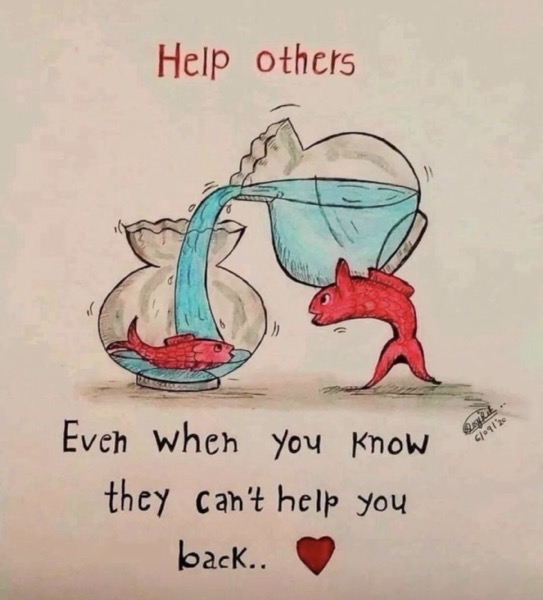
I came across a simple drawing the other day. Two fishbowls. One upright, with a fish swimming in clean water. The other broken and tipped on its side, with a second fish stranded and gasping. The first fish has somehow tipped its own bowl over to pour what water it had into the broken one. The caption read, “Help others. Even when you know they can’t help you back.”
It stopped me. May is Mental Health Awareness Month, and that picture says more than most of the campaign material I’ve seen this month combined.
Look at the image again. The fish doing the pouring is giving up something it needs to survive. It’s not running a calculation. It’s not waiting for a thank you. It’s not asking whether the other fish will return the favor later. It’s pouring because the other fish is dying, and the math of “what do I get out of this” has been set aside.
That’s what real help looks like. Not a LinkedIn post. Not a graphic with a hotline number on it. An actual decision to give something you don’t have to spare to a person who can’t pay you back.
The Industry I Work In
I’ve been in technology for a long time. I’ve watched DBAs work 36-hour go-lives and then get a Slack message at 6 a.m. the next day asking why a query is slow. I’ve seen architects carry the weight of multi-million-dollar migrations and never once hear “are you okay?” from anyone above them. I’ve seen consultants — myself included — pour ourselves into client problems while quietly running on fumes at home.
Tech is a hard industry to be a human in. The pager doesn’t care that your kid is sick. The auditor doesn’t care that you haven’t slept. The board meeting doesn’t move because someone on your team just lost a parent.
And yet, the people doing this work are people. They have bad weeks. They have anxious nights. They have moments where they sit in the car in the driveway and can’t make themselves go inside.
If you haven’t been there yourself, I promise you someone on your team has.
Why We Stop Pouring
The reason we hesitate to help is that most of us are running close to empty ourselves. The honest version of “I’m too busy to check on him” is usually “I don’t have anything left over to give.” That isn’t a moral failure. It’s a human one.
But here’s what I’ve learned the hard way. The act of pouring some of your own water into someone else’s bowl does not deplete you the way you think it will. A ten-minute call with a colleague who’s struggling won’t break you. Asking a junior engineer how they’re actually doing — and waiting for the real answer, not the polite one — won’t cost you a project deadline.
What costs you is the version of this industry where nobody asks, nobody notices, and the person who finally cracks does so quietly and alone.
What This Looks Like on a Tuesday Morning
You don’t need a program for this. You don’t need an HR initiative. You need to do one of these things this week.
Call the person you’ve been meaning to call. Send a real message to the colleague who has been quiet lately — not “how are you” but “I noticed you’ve been heads-down. Want to grab fifteen minutes?” Tell the engineer who pulled a brutal week that you saw it, and that you’re grateful. Forgive the email that didn’t get answered. Let the person who is struggling off the hook for something small.
If you’re the one struggling, tell someone. Tell your partner. Tell your manager, if you have a manager worth telling. Call or text 988 if it’s darker than you can carry alone. The version of you that asks for help is not weaker than the version of you that doesn’t. It’s the one that’s still here next year.
For the Leaders Reading This
I spend most of my writing time talking to executives, so let me speak plainly to that audience too. The cost of a burned-out senior engineer isn’t abstract. It’s attrition. It’s the project that slips. It’s the incident that gets missed at 3 a.m. because the on-call rotation has been ground down to people who are no longer at full strength. It’s the institutional knowledge that walks out the door because nobody noticed it was already halfway out.
A culture where people check on each other isn’t soft. It’s operationally sound. The teams that take care of their people retain their people. The teams that don’t, don’t.
If you want a business case, that’s one. But I’d rather you not need a business case for this. I’d rather you do it because someone on your team is a person, and so are you.
The Point
The fish in the picture isn’t a hero. It’s just doing the obvious thing. The remarkable part of the image isn’t the act. It’s that the act feels remarkable at all.
Help anyway. Even when you’re tired. Even when they can’t help you back. Especially then.
If this post landed for you, do me a favor. Don’t reply to me. Reach out to the person you thought of while you were reading it. Send the message. Make the call. Pour the water.
If you are the one who needs the water poured, call or text 988 in the United States. Someone will answer. You’re worth the call.
Please follow and like:


Bobby Curtis

I’m Bobby Curtis and I’m just your normal average guy who has been working in the technology field for awhile (started when I was 18 with the US Army). The goal of this blog has changed a bit over the years. Initially, it was a general blog where I wrote thoughts down. Then it changed to focus on the Oracle Database, Oracle Enterprise Manager, and eventually Oracle GoldenGate.
If you want to follow me on a more timely manner, I can be followed on twitter at @dbasolved or on LinkedIn under “Bobby Curtis MBA”.
Follow if you like:


