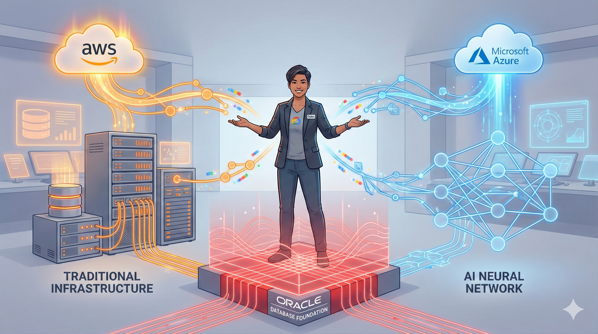
Database administrators are a unique breed of IT workers. At some point in your career, you were either guided toward this path by a mentor who saw something in you, or you took on the mantle yourself—maybe out of necessity, maybe out of curiosity, or maybe because nobody else wanted to touch the database and you weren’t afraid to dive in. However you got here, you were entrusted with the keys to the kingdom. Whether supporting a small business with a single database, a large organization with dozens of instances, or an enterprise with data sprawling across continents—the responsibility landed on your shoulders. And you carried it.
That history is exactly why I’m excited to write this post.
As more and more is discussed around AI, it is safe to say that AI is not going anywhere. If anything, it is here to stay—and for career database administrators, this represents one of the most exciting inflection points we’ve seen in decades. The skills you’ve built, the knowledge you’ve accumulated, the instincts you’ve developed? They’re about to become more valuable than ever.
If you are in your mid-career stage or towards the end of your career, you might be hesitant about adding another tool to your already impressive toolkit. After everything you’ve mastered—the late-night recovery operations, the performance tuning victories, the migrations that everyone said couldn’t be done—learning something new might feel unnecessary. But here’s what I want you to see: artificial intelligence isn’t here to replace what you do. It’s here to amplify it.
The database world is evolving, and DBAs who embrace this change aren’t just surviving—they’re thriving. Let me show you why this moment should have you energized, not anxious.
The Changing Data Landscape
The traditional relationship between users and databases has always required translation. Business users think in terms of “employees,” “sales figures,” and “customer orders.” Databases store that information in tables with names like HR_PER_ALL_ASSIGNMENTS, columns labeled amt_usd, and relationships defined by cryptic foreign keys. Skilled developers and analysts served as interpreters, writing SQL to bridge the gap between business questions and technical schemas.
Large language models are disrupting this paradigm in the best possible way. Tools like Oracle’s Select AI now enable users to ask questions in plain English and receive accurate SQL queries in return. The promise is revolutionary: democratized data access, faster insights, and reduced dependency on specialized technical skills.
But here’s where it gets interesting for us. LLMs are only as effective as the context they receive. When a model encounters ambiguous identifiers like T1, C123, or emp_id, it must guess at meaning, infer relationships, and hope its assumptions align with reality. The result is often flawed queries—wrong joins, incorrect filters, and unreliable results that erode trust in AI-powered data tools.
This is our moment. This challenge creates an opportunity for DBAs to step into an expanded role: not just managing database infrastructure, but curating the knowledge layer that makes AI effective. The business needs someone who understands both the technical schema and the business meaning behind it. That someone is you.
The Evolving Role of the DBA
The rise of AI doesn’t diminish the importance of database administrators—it elevates their strategic value. Traditional DBA responsibilities around performance, security, and availability remain essential. But AI introduces exciting new dimensions to the role that position DBAs as critical enablers of enterprise AI initiatives.
From Technical Expert to Knowledge Curator
DBAs possess something invaluable: deep understanding of how organizational data is structured, related, and used. This institutional knowledge—often carried in the heads of experienced DBAs rather than documented anywhere—is precisely what AI systems need to function effectively. The DBA becomes responsible for capturing and maintaining this context in a form that LLMs can consume.
Think about it. How many times have you known exactly why a column was named a certain way, or understood the business logic behind a particular table relationship? That tribal knowledge in your head—the stuff you’ve accumulated over years of working closely with developers, analysts, and business users—is now gold for AI systems. You’re not just a DBA anymore. You’re becoming the bridge between raw data and intelligent systems.
From Reactive Support to Strategic Partnership
When AI-powered applications struggle to generate accurate queries, the root cause often traces to gaps in how the database communicates its meaning. DBAs who can diagnose and address these gaps become essential partners to application developers, data scientists, and business intelligence teams building the next generation of intelligent applications.
This is a shift I find genuinely exciting. Instead of waiting for tickets to come in about performance issues, you’re now proactively shaping how AI interacts with your data layer. You’re not just maintaining systems—you’re architecting the future of how your organization accesses and understands its data.
From Data Guardian to AI Governance Leader
Organizations deploying AI must carefully manage what information AI models can access and interpret. DBAs are naturally positioned to govern this semantic layer, ensuring that AI systems receive appropriate context while sensitive information remains protected.
You’ve spent your career protecting data from unauthorized access. Now you’re extending that expertise to a new frontier—protecting AI from making unauthorized assumptions about what that data means. It’s a natural evolution of the guardian role you’ve always played.
New Skills for the AI Era
This evolution invites new skills into your repertoire—and honestly, that’s part of what makes this fun. Here’s what to explore:
- Understanding how LLMs consume metadata: You don’t need to become a machine learning engineer, but learning how these models interpret database schemas and comments opens up fascinating possibilities. It’s like learning a new dialect of a language you already speak fluently.
- Collaborating with business users: Capturing terminology and relationships means more conversations with the people who actually use the data. For many DBAs, this is a welcome change—finally, a reason to get out of the server room and connect your technical expertise directly to business outcomes.
- Thinking about data as a knowledge system: Not just rows and columns, but a semantic layer that AI can navigate intelligently. This is higher-level thinking that leverages everything you already know while pushing you to see your databases in a new light.
Oracle Database 26ai provides the tools to make this evolution concrete. The platform is built from the ground up to support AI-ready database architectures, and DBAs who understand how to leverage these capabilities will find themselves at the center of their organization’s AI strategy.
The Bottom Line
I’ve been in this industry long enough to see several waves of “the next big thing” come and go. AI is different. The velocity of adoption, the enterprise commitment, and the practical applications I’m seeing in the field tell me this isn’t just hype—it’s a fundamental shift in how data will be accessed and utilized.
But unlike previous shifts that sometimes left DBAs scrambling to stay relevant, this one plays directly to our strengths. Our deep knowledge of data architecture, our understanding of business context, our experience governing and protecting critical information systems—these are exactly the capabilities organizations need as they build AI-powered futures.
For DBAs, this isn’t a threat to navigate. It’s an opportunity to seize. We can bring our decades of expertise into the AI era, becoming more valuable and more strategically important than we’ve ever been. The organizations that succeed with AI will be the ones with DBAs who stepped up to shape how intelligent systems interact with data.
I don’t know about you, but I find that genuinely exciting. After years of being the behind-the-scenes heroes keeping the lights on, we’re being invited to the front of the room to help architect what comes next.
Let’s enjoy the ride.
Please follow and like:


Bobby Curtis

I’m Bobby Curtis and I’m just your normal average guy who has been working in the technology field for awhile (started when I was 18 with the US Army). The goal of this blog has changed a bit over the years. Initially, it was a general blog where I wrote thoughts down. Then it changed to focus on the Oracle Database, Oracle Enterprise Manager, and eventually Oracle GoldenGate.
If you want to follow me on a more timely manner, I can be followed on twitter at @dbasolved or on LinkedIn under “Bobby Curtis MBA”.
Follow if you like:


